


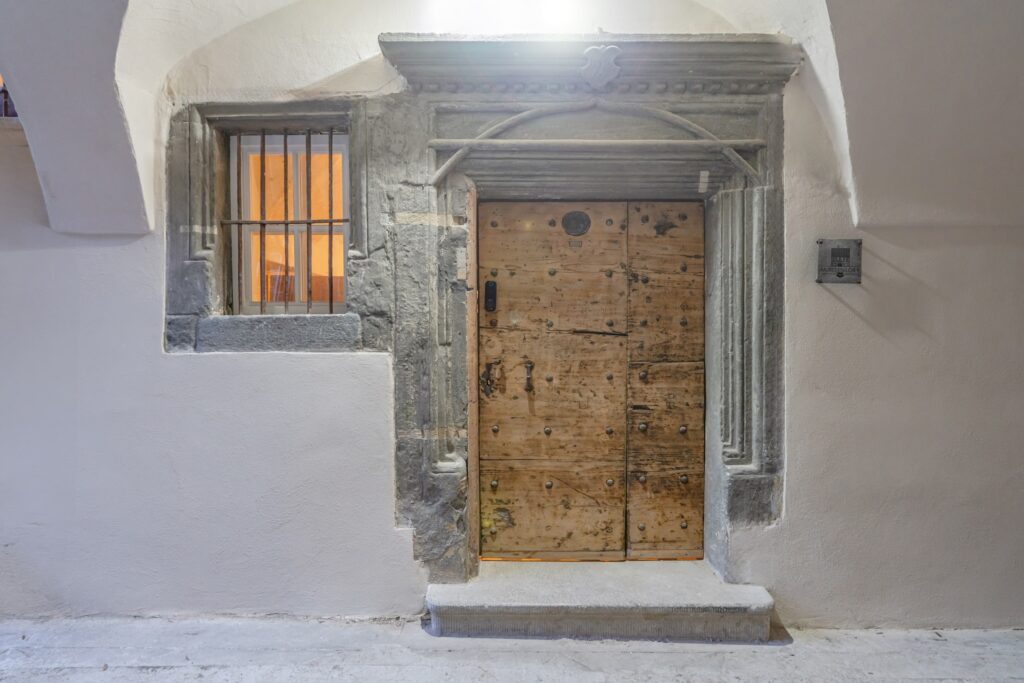
Your journey back in time starts right at the entrance, after you have crossed the gangway, as soon as you reach the door. You can see the year of construction carved in stone, 1550, on the frame with its Renaissance motifs such as the dentils of the cornice.
And the wood of the door, which you just opened, is from the 17th century. You have the feeling that you’re walking through a real-time portal that suddenly takes you to another time.

With its stone vaults, the cellar down the stair to your left is the oldest part of the house, dating from the mid-16th century or perhaps even older than that. The door is newer, from the 17th century. And if you look carefully at the ironwork facing the courtyard, you’ll see traces of the old cellar entrance and a wooden step, also from the 17th century.
As you enter the house, on the right-hand side of the entrance hallway, you can see the frame of a bricked door. Originally, these frames were painted in bright colors that have faded over time. The door, now bricked up, opened into the workshop and later into the shop on the street.

Above you, the Renaissance vaults, as built by the skilled craftsmen of the 14th century, criss-cross, and a 19th-century iron grille greets you at the foot of the interwar staircase. You climb the steps in a huff to get upstairs, curious to discover more.
The first things you notice upstairs are the characteristic 17th-century vaults and the checkerboard floor — half done in the 1930s, the other half recently, when the house was restored. If you look to your left, you see old wooden steps from the 17th century, and a spot in the floor covered with thick glass, through which you can see two layers of flooring: the first and oldest is stone, from when the house was built; the second is brick, burned in the 17th century.

And, as you walk to the opposite side, it’s impossible not to notice the imprint of a dog’s paw, preserved on that 17th-century brick.

Two other Renaissance elements follow: the loggia, above the gangway in the courtyard, and the stone column supporting it. The loggia was originally open and the column was painted in bright colors, which have not survived.

In apartment 11 (VON SCHÖBELN) you can see traces of old 19th-century paintings, two cupboards framed with art nouveau doors from the same period, and a niche in which an inscription from 1826, signed by the craftsmen who modernized the house, was found. You can see a framed reproduction of this document in the upstairs hallway. And although they look new, the restored doors of the three upstairs apartments are from the 19th century.


READ THE DOCUMENT (TRANSLATED FROM GERMAN)
Year 1826. During the renovation of the front sitting room, this opening to the upstairs neighbor, which existed as a sign of the undivided ownership of the wall in question, was not bricked up, but merely covered with bricks for the purpose of beautifying the room. The full validity of the right connected with such openings has, therefore, lost none of its force, as the opening must be regarded as open. Present were the master masons and workers: master mason Georg Thiefs, Jakob Teutsch, Thoman Zacharias; master mason: Johann Huber; apprentice: Christian Siegel; workers: Andreas Weber, Imre Josef, Szűts Miklos, Gőntze Janos, Kiss Ignatz and Emanuel Josef.
Kronstadt, August 19, 1826
Franc. nobilis de Schobeln,
Legal Secretary of the Magisterium, Allodial Collector


