


Standing for 500 years


Restored with great care and designed to provide every comfort to the traveler, MUREȘENILOR 9 offers an exquisite blend of ancient history and modern sophistication, combining the architectural mastery of past eras with premium facilities in a unique urban sanctuary.
Few houses in the old citadel of Brașov were left standing after the fire of April 1689, the second great plague to strike since the Turkish invasion in 1421.
Helped by the strong wind and the many wooden buildings, the fire spread quickly that day, destroying everything in its path. In just a few hours, Transylvania’s richest city became a blackened ruin, and for many years the heavy smell of smoke could not be driven out of the citadel. Most of the houses, warehouses and workshops had burned to the ground, the famous library founded by the printer Johannes Honterus had burned to ashes, the walls and defensive towers of the city were crumbling, and nothing but stone remained of the Lutheran church, known today as the Black Church. Unlike the devastation wrought by the Turks in 1421, when it took six years to rebuild the fortress, rebuilding after the great fire of 1689 took decades or even a century in the case of the Black Church, which was finally completed in 1772.
Only a few of the stone houses of the Saxon bourgeoisie, those on the north side of the city near the Lutheran church, miraculously escaped the fury of the flames. Among them was a house on Klostergasse, today’s Mureșenilor Street, whose Renaissance-style entrance frame had been carved by craftsmen with the year of construction, 1550.
It was quite a young house, only 139 years old, which suddenly became the oldest in the city of Brașov, after the others, much older, were destroyed by the fire. All that remained of the proud houses built by the first generations of Saxon settlers were the ruins and the memories of the survivors. Still, the house on Klostergasse has continued to tell its story through the ages and transformed with the city reborn from its ashes, remaining to this day a silent witness to the history of Brașov, a symbol of survival and continuity at the same time.
A historical monument


BV-II-m-A-11467 is not the secret cypher of some treasure-hiding vault, but the identification code of a treasure house in the List of Historical Monuments, established by the National Heritage Institute: architectural monument (m) of national interest (A), in Brașov (BV), with the unique order number 11467.
The stone frames from 1550, the cellar from the same period, the Renaissance arches from the 17th-18th centuries, the 18th-century iron gate, the loggia and the stone column on the first floor, built in the 16th-17th centuries, the baroque columns with Corinthian capitals and the two art deco pyramidal elements of the facade renovated in the 19th century, the 17th-century multi-layered roofing, the 19th-century tiles in the shape of scales with pointed tips, the carpentry from the 17th-18th centuries — all of them gathering centuries under the same roof, all of them being undeniable landmarks of the history of Brașov’s architecture, all of them fascinating reflections of a unique building, the MUREȘENILOR 9 house.
Renaissance (1501-1600)


In Europe, the 16th century was marked by the Renaissance and the reform movements that shook up the religious order. While art, science and philosophy flourished at the great courts of Italy, France and Spain, the new trends reached Brașov via the Saxons and merchants from all over the world. Thanks to Johannes Honterus, who brought the printing press to the city in 1533, Brașov became an important center of the Protestant Reformation.
Built in the full Renaissance period, the house reflects the architectural style of the time with its stone frames and sturdy structure, typical of the Brașov Saxon bourgeoisie, the city becoming an important educational and printing center at that time.
Baroque (1601-1700)


The 17th century brings a series of religious and political conflicts in Europe, such as the devastating Thirty Years’ War (1618-1648), which indirectly affects Transylvania. Although not directly involved in the conflict, the region came under political pressure as it was caught in the middle between the Ottoman and Habsburg empires.
Despite the difficult times, the fortified Brașov continued to develop and remain a true commercial and cultural center, with the von Schöbeln family’s printing house playing a key role until 1689, when the city was almost entirely destroyed by catastrophic fire. Remaining standing thanks to its solid architecture, the house was extended and modified, reflecting the new Baroque style of the time.
Enlightenment (1701-1800)


The 18th century in Europe is marked by the Enlightenment, a cultural and intellectual movement emphasizing reason, science and human rights. Revolutions and wars of independence, such as the American and French Revolutions, break out everywhere, while Habsburg influence grows stronger in central and eastern Europe.
However, Brașov, reborn from the ashes of the fire of 1689, continues to flourish. The von Schöbeln family influences the city’s cultural and administrative life, and the family printing works contribute greatly to the spread of Enlightenment ideas.
The house expands during this period and the architectural elements are remodeled in the Baroque style of the time.
Revolutions (1801-1900)


The 19th century is the age of great revolutions and rapid industrialization across Europe. In addition to the Industrial Revolution, the 1848 Revolutions had a major impact on political and social life. In this context, Romanians fight for their national rights, seeking to assert their identity in the face of Hungarian and Austrian rule.
Johann Gött, the city’s last great printer, carries on the von Schöbeln family’s printing legacy, contributing to the cultural development of Brașov and supporting the national movement. It is a frenetic period, during which the house undergoes further alterations to make the changes possible, thus becoming a thriving cultural and typographic center.
Wars and communism (1901-1989)


The 20th century brought profound changes to Europe and the world — two world wars, followed by a period of extensive reconstruction and cultural and economic transformation. After the First World War, the great empires crumble and Europe’s borders are redrawn, changing the status of Transylvania, which becomes part of Greater Romania through the Great Union of 1918.
Brașov, known for its vibrant ethnic diversity, enters a period of economic and cultural prosperity, until the Second World War ravages Europe, leaving behind destroyed cities and decimated communities. Brașov suffers, and its suffering continues after the war.
During the communist regime, buildings in the historical center are nationalized and transformed to serve new social policies. The house in which great ideas once saw the light of day is mutilated, divided into apartments and commercial spaces, and the old interior elements are largely destroyed or modified to suit the residential purposes imposed by the new era.
While Brașov is rapidly industrializing, historic buildings are neglected. The house on Mureșenilor, dating back to 1550, still survives, having been added to the list of historic monuments in 1955. This means that major destruction bypasses it.
The 1989 Revolution gives the city the chance to rediscover its cultural and historical values, and MUREȘENILOR 9 steps into the 21st century with a new identity, unchanged in structure, but full of stories of a Brașov reborn from its own ashes, shaped by history and able to confidently welcome the future.
Rebirth (2024)

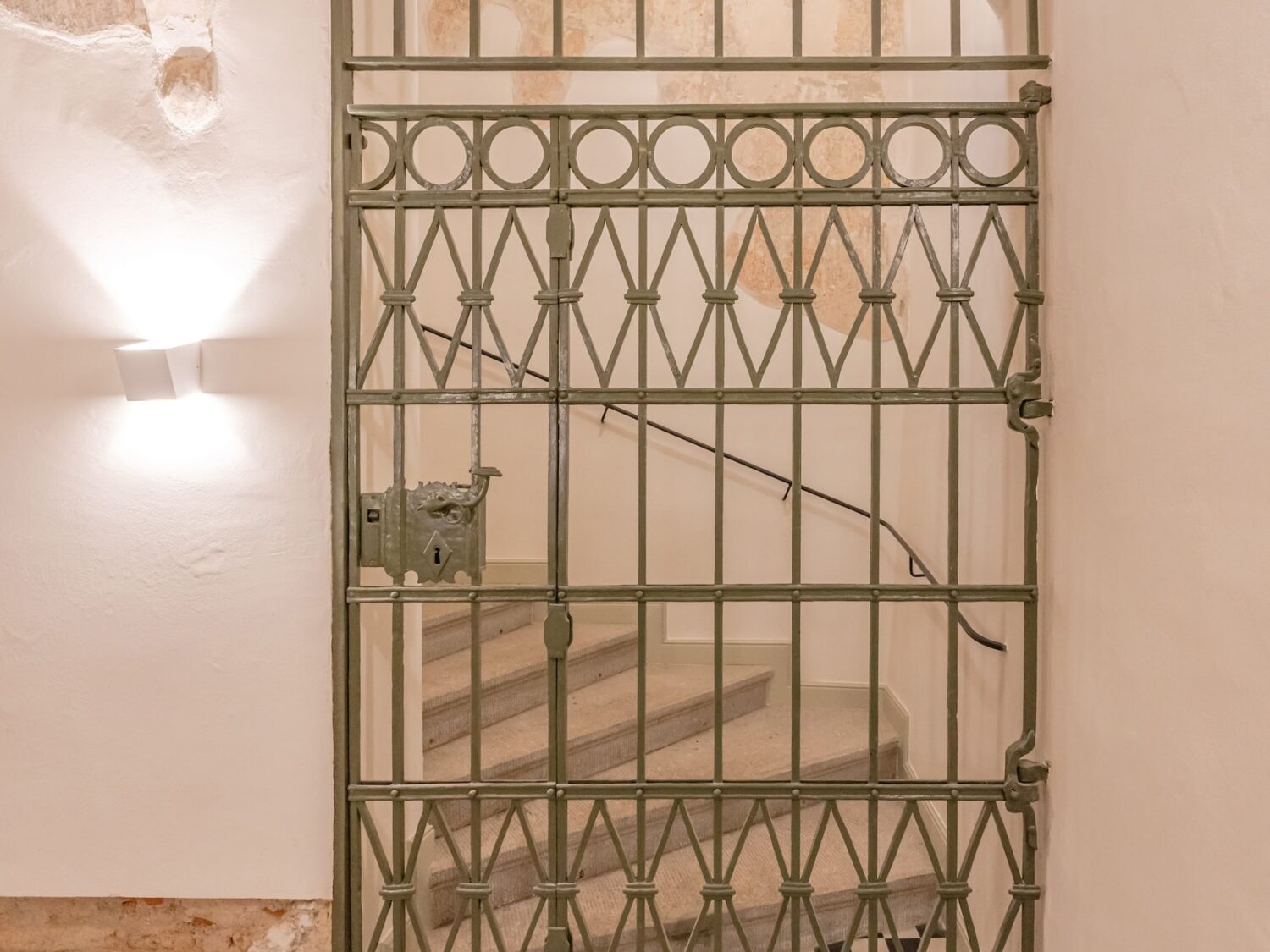

Restored with love and care in the architectural spirit of the past centuries, MUREȘENILOR 9 is now ready to welcome guests in an atmosphere that combines the elegance of past eras with contemporary refinement to offer a unique, memorable experience.
The interior has been completely refurbished, harmoniously blending modern elements — finishes, new furniture and state-of-the-art technology — with authentic old details that tell the captivating story of where past and present meet.
Today, MUREȘENILOR 9 is more than a symbol of Brașov, it is a gateway to living history, meant to delight, inspire and remain forever in the hearts of those who cross its threshold.
The restoration project was coordinated by Arch. Horațiu Vasilescu, and the interior design in collaboration with designer Raluca Maria Olaru. The execution was entrusted to the restorer Elena Avram.